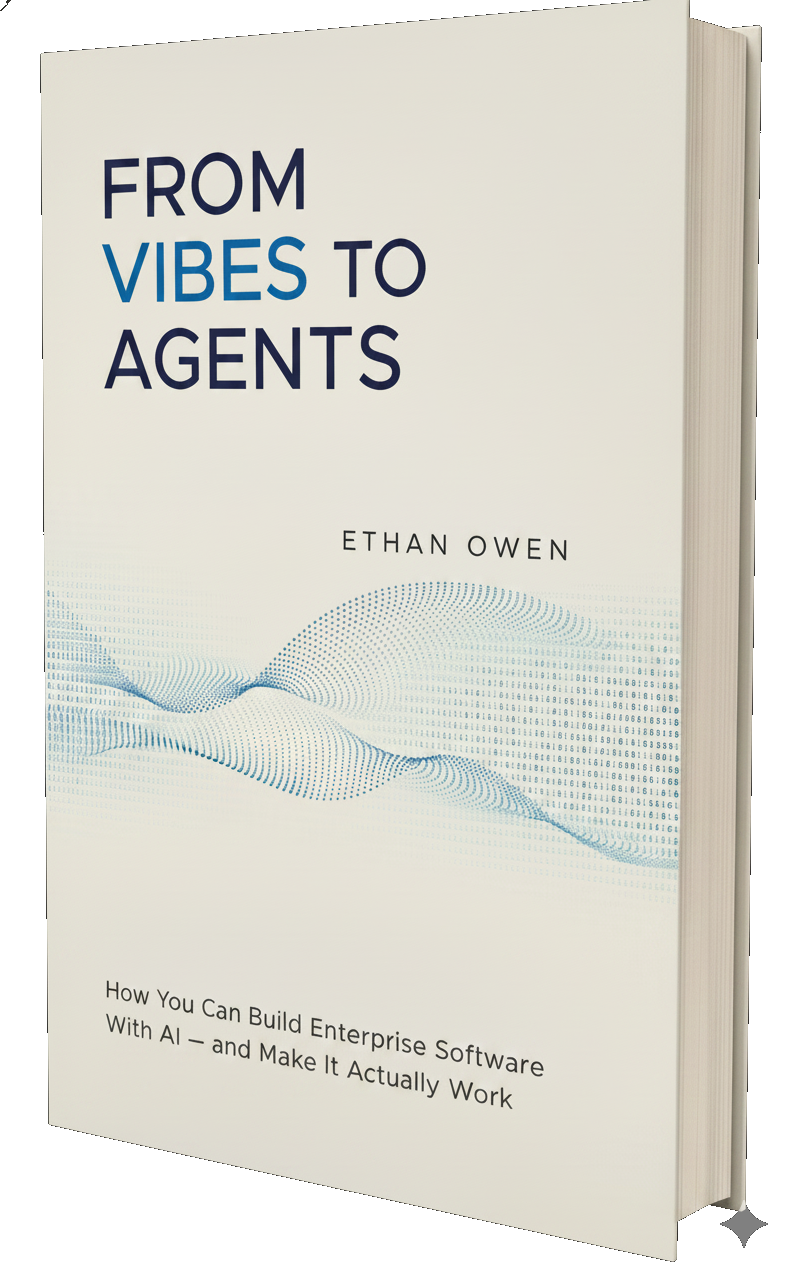
From Vibes
to Agents
How a non-engineer built enterprise software with AI — and the governance system that made it actually work.
92,000 words · 16 chapters · 4 appendices · DRM-free PDF + ePub
You've been through the wizard phase. Now what?
The first two weeks of building with AI are magic. Features appear in hours. You feel invincible.
Then the system starts breaking.
The AI forgets what you told it yesterday. It claims features are complete when they aren't. It changes one file and breaks fifteen others. It guesses at database columns instead of checking. It builds three features on an assumption — and the assumption is wrong.
You're not imagining it. These aren't bugs in the model. They're structural failure modes that every AI model has. Better prompts won't fix them. A better model won't fix them.
You need a system.
Fourteen months. Forty-five incidents. One system.
From Vibes to Agents is the story of building that system — from the inside, under real pressure, with a real business depending on it.
Ethan Owen is co-founder and COO of a luxury furniture and fixtures company. He studied cultural anthropology at Cornell. He's never been a software engineer. And he built an enterprise platform with AI agents governed by a framework he designed from scratch.
The book is the journey from chaos to structure. Every rule exists because something broke. Every verification type exists because a claim turned out to be false. Every automated hook exists because a manual check was forgotten.
Not theory. Practice. Battle-tested in production.
The system, by the numbers
What you'll learn
The 7 Failure Modes
Why ungoverned AI breaks — not occasionally, but structurally. The patterns that repeat until you build defenses against them.
Rules That Work
How to write rules AI will actually follow. Not suggestions. Enforceable law. The anatomy of a good rule vs. a useless one.
Memory That Persists
A system that makes AI learn from its mistakes across sessions. Corrections that stick. Context that carries forward. Permanently.
The Verification Mindset
50+ verification types that replace "the AI says it works" with proof. Commands, expected outputs, mechanical certainty.
The Incident Loop
How every failure makes the system permanently stronger. The mechanism that turns bugs into investments. The centerpiece of the framework.
Automated Enforcement
32 hooks that run without human intervention — catching pattern violations, secrets exposure, and blast radius issues before code leaves your machine.
Planning Before Building
Why AI needs a blueprint. The blast radius principle. The plan-audit loop. A golden path from requirements to production.
The Knowledge Graph
64 structured tools that give AI a map of your codebase — not just files, but how they connect. Impact analysis, dependency tracing, MCP bridge, and schema validation.
Tech Intelligence
A platform that turns article reviews into competitive advantage. 150+ structured reviews scored for relevance, generating 78 concrete implementation plans.
The Playbook
A maturity model from zero governance to full agentic engineering. Week-by-week plan to build your own system. Start the day you finish reading.
This book is for you if...
You're a solo founder building with AI and wondering why everything keeps breaking
You're a technical leader watching vibe coding create debt across your team
You're a non-engineer with domain expertise who wants to build real software — not prototypes
You're a CTO evaluating AI agents in production and asking "what's the governance model?"
You've been through the wizard phase and you're looking for what comes next
Three ways to start
Instant DRM-free download. Secure checkout via Lemon Squeezy. 30-day money-back guarantee.
The Book
The complete book in DRM-free PDF and ePub. Read it on any device, annotate it, share it with your team. Yours forever.
- Full 16-chapter manuscript
- 4 appendices with starter templates
- PDF + ePub formats
- DRM-free — yours forever
Builder's Bundle
The book tells you what to build. The bundle gives you the building blocks.
- Everything in The Book
- 1 year of Massu Pro access
- 59 workflow commands
- Rule templates & verification types
- Hook configurations & pattern scanner
- Standalone appendices as ready-to-use docs
- Future book updates included
Includes 1 year of Massu Pro ($29/mo value) as a free trial. We do NOT auto-bill — the trial ends and you continue on Free unless you explicitly upgrade with your consent. Book is yours forever.
Team License
Roll out AI governance across your team. $20 per person for a complete implementation kit.
- Everything in Builder's Bundle
- Share with up to 10 team members
- 1 year of Massu Team access
- Team onboarding guide (5-page condensed framework)
- Priority access to workshops
Includes 1 year of Massu Team ($499/mo value) as a free trial. We do NOT auto-bill — the trial ends and you continue on Free unless you explicitly upgrade with your consent. Books are yours forever.
Coming to Amazon Kindle and Paperback shortly. Need the full Massu platform? See plans →
About the Author
Ethan Owen grew up on summertime archaeological digs. He spent his formative years watching teams methodically uncover things that had been buried for centuries — absorbing, without knowing it, the discipline of systematic work. You don't dig randomly. You work in grids. You document every layer. The process is as important as the discovery.
That sensibility followed him into cultural anthropology at Cornell, where he studied how human societies build governance systems to manage complexity. Then to the Monterey Institute of International Studies for international policy. He lived in Germany, Singapore, and China along the way, each place adding a layer of understanding about how different cultures approach the same fundamental problems.
His career began in web design, moved into interface design, and landed in user experience at eBay, MissionFish, PayPal, and Visa — a senior designer at Visa's Asia-Pacific innovation center, running design-thinking workshops. That's where he learned to design for constraints: creating structures that guide people toward good outcomes without them feeling constrained.
He now runs operations for Limn, a luxury furniture and fixtures company that creates high-end pieces for large-scale architectural projects. Coordinating design and production with factories in Indonesia taught him the cost of rework and the discipline of quality control — lessons that turned out to apply directly to software built with AI.
In 2025, he started building enterprise software using AI agents and discovered that intelligence without governance produces impressive inconsistency. So he built the governance. The system he created — 45 rules, 45 incident post-mortems, 50+ verification types, 32 automated hooks — became the foundation for Massu AI, an open-source core governance platform for AI development.
Questions
No. The author isn't one. The book is written for people with technical literacy — you understand what databases, APIs, and frontend code are — but who don't write production software for a living. Engineers will also get value, especially from the governance framework and incident loop.
The principles are tool-agnostic. The book was written using Claude Code, and most examples reference that workflow, but the governance framework works with any AI development tool — Cursor, Copilot, ChatGPT, or whatever comes next. The principles are about structure, not tooling.
Massu AI is the open-source platform that implements the governance framework. The book teaches the principles; Massu provides one implementation of those principles. You can build your own system from scratch using only the ideas in the book, or start with Massu and customize from there.
About 92,000 words across 16 chapters and 4 appendices. That's roughly 350 printed pages. Dense but readable — no filler, no fluff, every chapter earned its place.
The book has everything conceptually. The bundle adds 1 year of Massu Pro — the governance platform with 59 workflow commands, rule templates, verification types, hook configurations, and the pattern scanner. Think of it as the difference between reading about a recipe and getting the mise en place pre-measured.
Available now. The Book and Builder's Bundle are available for instant DRM-free download here on this page. Amazon Kindle and Paperback editions are in review and will launch shortly — when they do, anyone who bought the Amazon edition can claim their bonus Massu Pro trial at /bonus.
Bought directly here? Full refund within 30 days, no questions asked. Once Amazon launches, returns for Kindle and print editions follow Amazon's standard policy.
The model isn't the variable. The system is.
Start building yours today.